CDC suspender buzzer
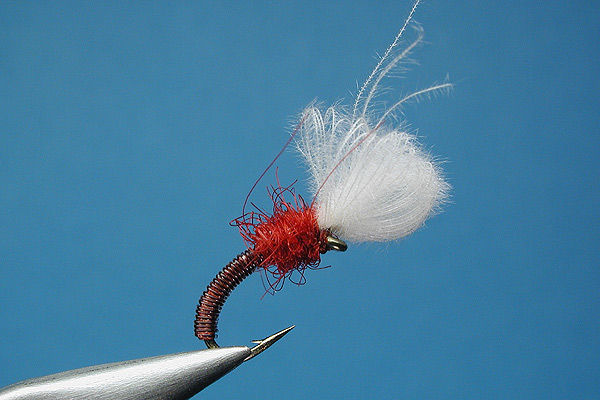
As stated before, in the UK style of stillwater/reservoir trout fishing, which is growing rapidly all over the continent as well, 'buzzers' or chironomid midges, in all stages of development are frequently the most important food organisms for the resident trout, apart maybe from scuds and 'coarse fish' fry, if present. During warm summer days these trout will often be totally preoccupied with buzzer pupae hanging in, or down from the surface film.
Fish as a dry, static to cruising fish. Use a patch of Amadou to occasionally dry the CDC loop.
Tying instructions:
- Place hook in vice, so that most of the bend is accessible. Attach
the tying thread to the hook and bring way down into the bend.
- Take a length of mono, crimp with pliers about .5 inch from one end. Tie in just
beyond the crimped area and wrap tying thread all the way to where the thorax will start (about halfway down shank). Cut the trapped end of the mono under 45 degrees and cover.
- Wrap the free end of the mono forward in
touching turns to where the thorax will start, crimp and tie off with
thread. Clip excess. Bring the thread to the eye.
- Choose two well-sized
(i.e. rather large) CDC feathers and place them on top of each other (same
curvature). Align tips. Tie in behind eye, with tips pointing backwards,
and butts extending beyond eye. Stroke barbules towards tips, make a loop
with the butts, bringing them back over the shank (the loop should be
about 1/2 to 2/3 time the size of the hook) and secure. Clip the butts.
Dub the seals fur or sub onto the thread and make a nice 'buggy' thorax
between the mono abdomen and the CDC loop just beind the eye. Whip finish
beneath the loop (i.e. between the CDC loop and the eye; three turns will
suffice - use no cement)